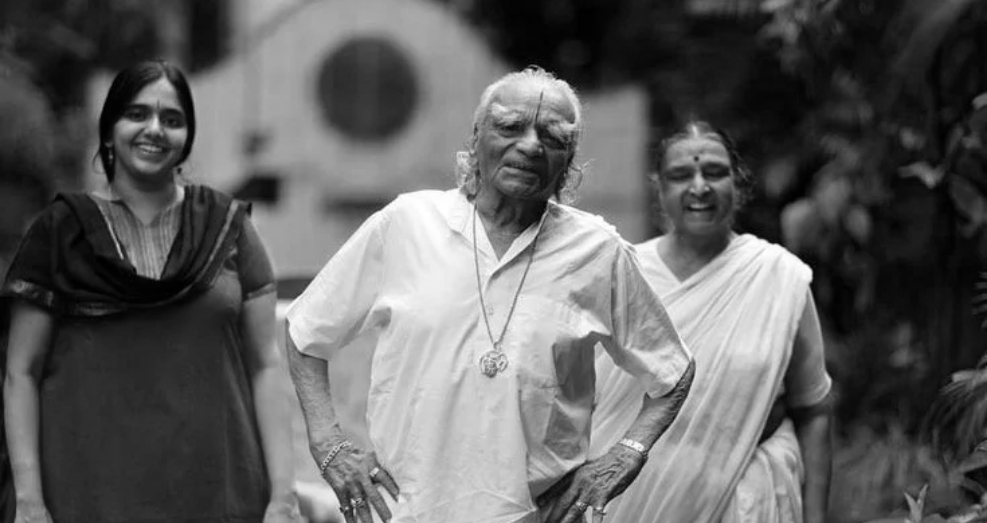
Members of the Iyengar Family: Abhijata Iyengar, B.K.S. Iyengar and Geeta Iyenga
B.K.S. Iyengar: A Yoga Pioneer's Journey
Born on December 14, 1918, in Bellur, India, B.K.S. Iyengar overcame a challenging childhood marked by poverty and illness. At 15, he embarked on a transformative yoga journey under his brother-in-law, T. Krishnamacharya.

A Lifelong Dedication to Practice and Teaching
In 1937, Mr. Iyengar began teaching in Pune, India, dedicating himself to rigorous study and daily practice. Over decades, he refined his understanding of the body, mind, and breath — developing a precise and accessible method of yoga.
A major turning point came when world-renowned violinist Yehudi Menuhin became his student, helping introduce Iyengar Yoga to the West. By 1956, Mr. Iyengar’s teachings had reached the United States and beyond.
Making Yoga Accessible to All
Mr. Iyengar revolutionized the practice by introducing props such as blocks, belts, and blankets — making yoga accessible to people of all ages and abilities. His detailed approach emphasized alignment, sequencing, and timing, helping students develop strength, mobility, and awareness.
His book Light on Yoga (1966) became an international bestseller and remains a foundational reference for practitioners worldwide.
A Legacy That Continues
In 1975, Mr. Iyengar established the Ramamani Iyengar Memorial Yoga Institute (RIMYI) in Pune, named in honor of his wife. Today, the institute continues to serve as the heart of Iyengar Yoga, guided by members of the Iyengar family — including Prashant and Abhijata Iyengar.
Mr. Iyengar continued practicing and teaching well into his 90s, leaving behind a global community and an enduring lineage of teachers and students.
Recognized by TIME magazine in 2004 as one of the most influential people in the world, his teachings continue to inspire practitioners seeking clarity, steadiness, and self-understanding — both on and off the mat.
Why Iyengar Yoga?
Iyengar Yoga is accessible to everyone. It’s known for its precision, timing, and the intelligent use of props — tools personally designed by B.K.S. Iyengar to make yoga approachable for all ages and body types.
This method helps students build strength, stability, and awareness while bringing balance to the body, mind, and emotions. Each class encourages mindful progression rather than performance — helping students move with understanding and confidence.
What also sets Iyengar Yoga apart is its standardized teacher certification system recognized worldwide. Certified Iyengar Yoga Teachers (CIYTs) complete years of in-depth training and assessment. Their expertise ensures clear instruction, thoughtful sequencing, and safe use of props to support each student’s needs.
Book a Class
Frequently Asked Questions About Iyengar Yoga
What is Iyengar Yoga, and how is it different from other styles?
Iyengar Yoga is the method of yoga developed by B.K.S. Iyengar over more than 70 years. Where faster-paced styles flow from pose to pose, Iyengar Yoga slows down so you can learn each posture in detail: not just the shape, but what it is doing in your body and why. Poses are held, teachers give clear instruction and individual corrections, and props are used so every student can work at the right level.
Is Iyengar Yoga good for beginners?
It is one of the best places to start, because the method assumes nothing and teaches everything. Our Foundations classes introduce the basic postures at a pace conducive to learning something new, and props make every pose accessible from day one.
Is it too late to start yoga at 60?
No. We have students who began in their 60s and 70s. Foundations 55+ is built for anyone feeling the effects of aging, and the method works at every stage of life because it starts where you are.
Do I need to be flexible?
No. Flexibility is something practice develops, not something you need to arrive with. Props fill the gap between where your body is and where the posture needs to go.
Can yoga help with back pain?
Many students come for exactly this reason and find real improvement over time. The attention to alignment changes how you stand, sit, and carry yourself, and our Yoga for a Healthy Back class is designed for anyone looking to care for their back.
What yoga props do I need?
None. Blocks, belts, blankets, bolsters, chairs, and wall ropes are all provided, and your teacher shows you how to use them. If you practice at home, a few blankets and a belt will take you a long way.
What is a Certified Iyengar Yoga Teacher?
A CIYT has completed one of the most rigorous certification processes in yoga: years of study, a demanding multi-day assessment, and demonstrated knowledge of anatomy, philosophy, and teaching. All our yoga classes are taught by CIYTs or by teachers training toward certification under their guidance.
Can I take Iyengar Yoga classes online?
Yes. Most classes run in the studio and live online at the same time, taught by the same certified teachers, and every membership covers both.
Which class should I start with?
Foundations if you are new to Iyengar Yoga or to yoga in general. Foundations 55+ if you are feeling the effects of aging and want a class that takes that into account. Not sure? Book a free orientation and we’ll place you.
Do I need a membership, or can I drop in?
Both work. New students can start with three weeks unlimited for $59. After that, choose a monthly membership, a 10-class pack, or a single drop-in. If cost is a barrier, ask us about our sliding scale.